
preloader

Not every dock fails at once.
Sometimes it begins with one wrong stone.

At first, the harbor feels solid.
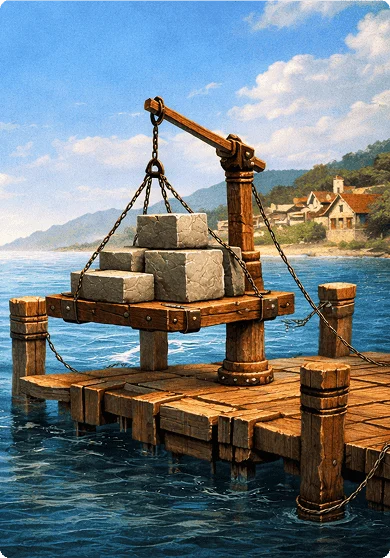
Massive platforms stand over dark water. Support beams look immovable.
The docks seem built to carry anything. Then you place a single block in the wrong position, and the balance shifts. One edge sinks. A pressure point strains. A section that looked permanent begins to crack under its own logic. Stone Harbor: Load Balance? It's this puzzle game I've been working on where you're basically just trying not to let everything collapse under its own weight. You know that gut-wrenching moment right before everything goes to hell? Yeah, that's pretty much the whole game - living in that moment of dread.
Start Playing Now

A harbor built from mass, pressure, and old engineering

Yeah, don't expect some cutesy harbor with bright colors and cartoon boats. This thing's all business - think heavy industrial, like the kind of place that smells like rust and diesel. Carved stone blocks everywhere, thick reinforced beams, the kind of place that was built to handle some serious weight.
Every surface should feel like it was built for endurance. Stone platforms, anchored supports, narrow transfer zones, and edges that can tolerate pressure only when the weight is distributed correctly. The setting matters because it explains the mechanic. In this world, cargo is not just something you place. It becomes part of the structure the moment it touches the dock.

You're not stacking cargo.
You're negotiating with gravity.

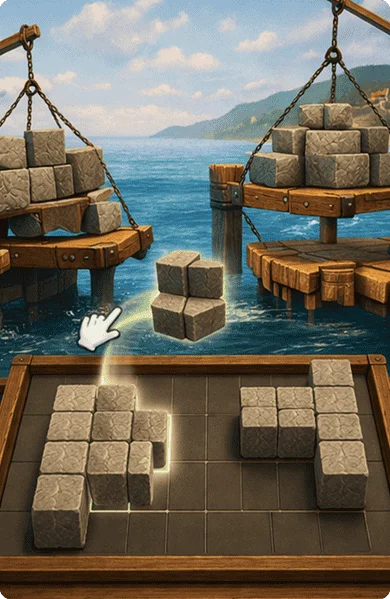
Every level basically comes down to this: place heavy stone blocks across the dock without screwing up the balance.
Sounds easy enough, right? But then you place that second block and suddenly everything's different. A platform that was stable with one load starts tilting with two. A support point that looked reliable reveals its limit. A safe-looking arrangement turns dangerous because the weight is correct in total, but wrong in distribution.
The thing is, balance isn't some abstract concept you're supposed to imagine - you can actually see it happening, feel the tension, and watch how every single move shifts everything else.

What the player actually does

  • Place stone cargo blocks on harbor platforms
  • Maintain weight equilibrium across the structure
  • Work with limited support points and fixed load zones
  • Prevent chain collapses caused by poor distribution
  • Adjust placement order to preserve stability during the whole sequence

Order matters just as much as where things end up. You might know the final solution, but getting there without collapsing everything? That's the real puzzle. Which honestly makes the whole thing way more interesting than I expected. Players are not only solving where the blocks belong — they are solving how the structure survives long enough to get there.

A harbor built from mass, pressure, and old engineering

Yeah, don't expect some cutesy harbor with bright colors and cartoon boats. This thing's all business - think heavy industrial, like the kind of place that smells like rust and diesel. Carved stone blocks everywhere, thick reinforced beams, the kind of place that was built to handle some serious weight.
Every surface should feel like it was built for endurance. Stone platforms, anchored supports, narrow transfer zones, and edges that can tolerate pressure only when the weight is distributed correctly. The setting matters because it explains the mechanic. In this world, cargo is not just something you place. It becomes part of the structure the moment it touches the dock.

A structure can look safe and still be on the edge

What's really cool is how something can look perfectly fine right before it all falls apart.
A platform may appear level while hidden pressure builds near one support. A heavy block placed near the center may still destabilize a connected edge. Some areas can hold more than they seem, while others collapse because the load arrived in the wrong order.
Honestly? About halfway through development, I had this moment where I was like 'wait, this isn't just another block-stacking game anymore.' People were actually thinking like engineers, which was way cooler than I expected. It's like being a structural engineer, but fun.

Collapse is rarely isolated

When balance fails, it should fail in a way that feels dramatic but logical.

A platform dips

A connected slab shifts

A support fractures

Another load slides into a worse position

The chain reactions aren't just eye candy - they actually teach you what you screwed up. You don't just see numbers when things go wrong - you watch the whole dock system react and fall apart. One mistake can travel farther than expected, and that is exactly what makes success feel earned.

The harbor becomes more demanding without becoming louder

The early levels teach basic equilibrium. One platform, a few blocks, obvious risks.
Then the game expands:

Multiple Connected Docks

Uneven Support Distributions

Heavier Cargo Shapes

Narrow Safe Zones

Multi-Step Placements Where Temporary Imbalance Matters

Rather than just making things arbitrarily harder, we focused on making the actual dock designs more intricate and interesting. The more players learn, the more subtle the problems become. Later levels should feel less like stacking and more like reading the hidden logic of a heavy system.

Weight should be visible before it is explained

Visually, everything needs to feel heavy and real - like you're working with actual stone and metal.
The harbor needs stone textures, weathered surfaces, deep water contrast, restrained industrial details, and platforms that feel old but dependable. Movement should be deliberate, never weightless. When a block lands, the player should almost feel the impact. When a support starts to strain, the visual language should show pressure without turning the interface into noise.
The landing page should follow the same tone: grounded palette, calm composition, subtle motion, strong structure, and a sense that everything here is built to carry something real.

Support tools for difficult structures

Since the game actually follows logical rules, any paid stuff should help you understand what's going on better, not just save you from random disasters.

Suggested features:

Hints that reveal unstable pressure zones

Undo options for risky placements

Extra support points for advanced levels

Additional challenge packs with new structural layouts

We don't want to hand you the answers, but sometimes you need a nudge to see what you're missing. We're not trying to let you skip the hard parts - we want to help you figure out why things work the way they do.

Because every stable solution feels deserved

There's this one level - Jesus, I must've spent three weeks just staring at it - that'll absolutely mess with your head, but in a good way. You'll start seeing weight distribution everywhere - even when you're loading groceries in your car.
At first, players look for empty space. Later, they begin to look for pressure, leverage, and sequence. They stop asking "where can this block go?" and start asking "what will this block do to everything around it?" And then it just clicks, you know? You stop thinking 'where does this go?' and start thinking 'what's this gonna do to everything else?'
Somehow it makes physics feel intuitive. Still tough, but in a way that gets under your skin - you'll catch yourself thinking about the puzzles hours later.

FAQ

  • 1.

    What kind of game is Stone Harbor: Load Balance?

    Stone Harbor? It's this physics puzzle thing where you're constantly on edge, trying to keep the whole damn harbor from collapsing. Players place heavy stone cargo across docks and platforms while trying to keep the whole harbor balanced. It's all about where you put the weight, how much your supports can handle, and watching everything react in real-time. It feels calm on the surface, but each decision carries real mechanical consequences.

  • 2.

    Is the game about speed or careful planning?

    This definitely isn't a twitch game. You'll spend way more time just staring at the screen, thinking, than actually clicking stuff. Players are expected to observe the dock structure, understand how weight is being distributed, and think a few steps ahead before placing anything heavy. The tension comes from pressure and sequence, not from a timer pushing you forward. That makes the game more thoughtful and precise than frantic.

  • 3.

    What makes the puzzle system interesting over time?

    The game starts with simple load placement, but the deeper appeal comes from how stability changes as the harbor becomes more connected. One block may affect more than one platform, and one correct-looking placement can still cause long-term imbalance elsewhere. As new structures appear, the player begins solving not just positions but entire load relationships. So it doesn't just get harder - it gets more interesting.

  • 4.

    What happens if I place a block incorrectly?

    A wrong placement can do more than make one section unstable. It may shift the pressure on a support, tilt a platform, or cause a connected area to collapse in sequence. When things collapse, it teaches you how the whole dock system works under pressure. Instead of feeling random, mistakes become part of learning the structure.

  • 5.

    Does the game rely on realistic physics?

    I mean, we're not trying to simulate actual engineering here, but it needs to feel believable, you know? Players need to understand that heavy loads create pressure, support points have limits, and distribution matters more than raw symmetry. The game does not need to become a full engineering simulator, but it should always feel consistent. That consistency is what makes the puzzles satisfying.

  • 6.

    Are there different types of cargo or block behavior?

    Yes, the concept supports variation in cargo size, weight, and shape. Some blocks may be compact and easier to place, while others create more difficult structural problems because of their mass or footprint. This allows later levels to introduce more interesting decisions without changing the basic mechanic. It also helps the harbor feel more alive as a working system.

  • 7.

    Can players get help if they are stuck?

    Yes, support tools can be included in a way that still respects the puzzle design. Hints may show unstable zones, undo tools may let players rethink a risky move, and optional support points can make harder structures more manageable. These features should not replace understanding, but they can reduce frustration when a level becomes especially tight. The core satisfaction should still come from reading the load system correctly.

  • 8.

    Who is this game for?

    If you're the type who gets frustrated when puzzle games cheat or don't make sense, this might be right up your alley. If you're into puzzle games where you actually have to think instead of just clicking fast, you'll probably dig this. It also suits players who appreciate a heavier visual atmosphere rather than bright or chaotic design. It's a puzzle game that feels substantial and unique compared to what's already available.